Consigli "Chianino" 2-Piece Olive Wood Handle Carving Knives best Cutlery Sets
You can easily remove rare rust spots if dish washer is used by pouring some lemon juice into a tall glass, and then soak the knives in the lemon juice for a few minutes. The acid in the lemon juice should help to loosen up the rust, and make it easier to scrub away after you pull them out of the glass (Hand-wash is highly recommended). Or simply scrub it away with a steel wool.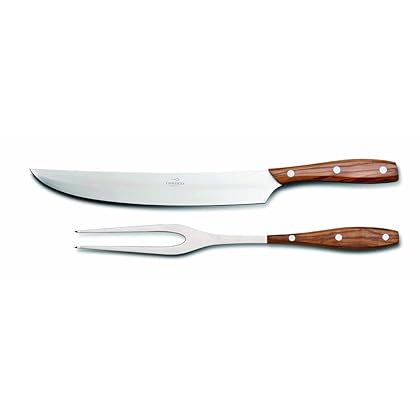

Why Use Consigli "Chianino" 2-Piece Olive Wood Handle Carving Knives ?
- Made from 420 grade stainless steel
- Includes 8 inch chef knife with 2.5 mm blade thickness; 8 inch bread knife with 2.5 mm blade thickness; 8 inch carving knife with 2.5 mm blade thickness; 5 inch utility knife with 2.5 mm blade thickness; 5 inch paring knife with 2 mm blade thickness; 6 pieces of 4.5 inch steak knives with 2 mm blade thickness and an acrylic stand for convenient storing of the knives
- These knives are a solid one piece stainless steel design so you don't have to worry about handles falling off
- Conservative blade thickness and elite design allow for easy handheld use
- Do not use dishwasher; hand wash is highly recommended; immediately dry with a napkin to prevent rust
- 13 piece set has conservative blade thickness and elite design that allow for easy handheld use
- Knife blades are made from 420 grade Stainless steel
- Polypropylene plastic is used on handles which possesses high flexural strength because of its semi-crystalline nature which is very resistant to moisture and has good chemical resistance over a wide range of bases and acids
- All knives store safely in the rubber wood knife block and for cleaning use hand clean and don't use dish washer
this colorful 17-piece cutlery set features ergonomic, soft-feel handles and FDA-approved, food safe decals that coordinate with Fiesta's famous line of dinnerware. Each knife is made of high-quality stainless steel and includes a protective sheath for blade protection and safety. Set includes Jacobean Decal Chef Knife, Ava Decal Bread Knife, Scarlet Santoku Knife, Cobalt Utility Knife, Sunflower Serrated Utility Knife, Lapis Sandwich Knife, Lemongrass Cheese Knife, Flamingo Paring Knife, Scarlet Shears, and 8 Coordinating Sheaths. As with all fine cutlery, hand wash is recommended. Dry promptly after washing for best results.
Consigli "Chianino" 2-Piece Olive Wood Handle Carving Knives is best for youFor generations, the Consigli family has been leveraging its passion and expertise to produce high-quality traditional Tuscan pocketknives and cutlery, using the same forging techniques that the master knifemakers of Scarperia have been refining since the 14th century. The town of Scarperia was founded on September 8, 1306. Back in those days, the town was sited on what was then the most important road for anyone wishing to cross Italy. The production of cutting irons has also been crucial to the town�s development from the outset; this specialization was perhaps the result of local military requirements or possibly due to the needs of the local farmers. For more than two centuries, blades from Scarperia were renowned as being of unrivaled quality. In the second half of the 19th century that Scarperia�s knives and cutlery started to experience increasing demand. With the unification of Italy came numerous orders from all over the country, and particularly from the south. Because of this southern influence, the origins of several types of knives made in Scarperia (the Calabrese, the Napoletano and the Casertano) can be traced back to the south of Italy. As a result, the reputation for the quality of the knives made here has been consolidated once again, and they are now rightly celebrated throughout the world. The Old Family Tradition Fifty years have now passed since the time of the Fondo Pasinetti - the site in Via Magenta, in the center of Scarperia, where the Consigli brothers opened their first premises. Luigi - at the time, just a little over 20 years of age - and Enrico, his slightly younger brother, had already spent several years producing knives on behalf of the same company for which their father had been forging metal and making pattada knives and grafting knives since the very early part of the century. Currently, alongside its typically Italian models, which represent the perfect synthesis of tradition, technique, elegance, and refinement, the company also produces high-quality table and kitchen cutlery that is expertly finished using noble materials like cow horn, buffalo horn and olive wood. The Consigli family is totally committed to authentic steel-working techniques and to the preservation of the values of manual processing. The Comet: A Symbol of History When holding a Consigli knife, it is easy - for the expert and the layperson alike - to appreciate the clean lines, the painstaking finish and the warmth of the natural materials. Opening and closing the blade, one comes to realize the precision and fluidity of the mechanism, and, on closer inspection, one makes out the almost imperceptible imperfections that highlight the authentic, hand-crafted nature of the knife. One's eye is drawn to the signature, (the pride of every true artisan), to the guarantee of reliability and to the symbol with which the Consigli brothers like to adorn their creations. Along with the sun, the comet is the astronomical symbol par excellence. It was used time and again in ancient graffiti and on coins, and was rediscovered centuries later by renaissance cutlers. Indeed, in accordance with the Statute of 1630, since that time all knifemakers in Scarperia have had to use their own version of the comet symbol. Consigli's comet has undergone a natural evolution over the decades. The latest redesign, dating from 2004, evokes luminosity and dynamism, appearing like an imaginary bridge between the drive to conserve traditional ideals and the drive towards the future. How a Knife is Made A perfect knife is the result not only of skilled workmanship but also of the care taken in selecting the very best raw materials. For this reason, the Consigli family invests considerable time and effort into searching out the finest horn available, and rigorous criteria are applied to ensure that the horn selected has all of the features that, throughout the centuries, only experienced cutlers have been able to identify. The wood used by Consigli is carefully selected and then seasoned for years, in order to guarantee its stability and workability. The steel used for the blades is of the highest quality, and has undergone exacting thermal treatments at the hands of a master craftsman to create the perfect synthesis between elasticity and durability. From the outset, the Consigli brothers have always supervised the end-to-end production process of their knives and cutlery. The steel components - blade, springs, etc. - are made by punching dies that (more often than not) have been produced by the same artisans who go on to make the knives themselves. The main pieces of the knife are stamped out of solid steel before undergoing the extremely delicate processes of tempering and quenching. These processes enhance the attractiveness of the knife and are an opportunity for the artisan to express his or her mastery of the art of knifemaking. Even today, the time-honored technique of allowing the knife to drop to the ground and listening to the sound it makes on impact is still used religiously to ensure that both the blade and the springs have the necessary properties of elasticity and durability. The temperature required to heat the steel until it is white-hot, as well as the time for which the blade must cool in oil, is still dictated by nothing more than the attentive eye of the cutler, who � having spent years at work in front of the furnace � has what it takes to calibrate his or her input perfectly. The same approach is applied to quenching, which is the process whereby the blade is heated again to eliminate the undesired fragility that steel acquires during tempering (which actually provides the blade with its hardness). Consigli continues to employ these tried-and-tested process not only because time has proven their worth, but also because they imbue the resultant knife with a tangible sense of history and tradition. Today, as always, Consigli knives are still made with horn handles, which are produced by quartering the whole horn, evaluating it closely, reading its secrets and caressing it to achieve the perfect orientation of the blade. Only in this way - with slow, ritualistic motions - is it possible to minimize flaking of the horn. Thanks to the experienced eye of the knifemaker, the finest veins can be selected in such a way as to reduce waste as far as possible. The handles are then heated in the furnace and passed through the flames carefully on the basis of their thickness, before being rounded off and made malleable so that they can then be flattened by the pressing process. Sawing, molding and leveling operations are carried out with patience. The outline of the unfinished blade is distinctive, making it possible to differentiate immediately between a zuava, a pattada and a mozzetta. In total, it takes around 40 separate operations to create a Consigli knife - the order of these operations varies from one model to the next, but each finished knife is the product of a series of processes, all of which require masterful manual dexterity. The cutting process prepares the way for the addition of the band; primary assembly - which usually takes place after the housing for the blade and spring has been hollowed out - makes it possible to assemble the main metal parts (blade and spring) and ensure they are firmly attached; secondary assembly sees the insertion of the mechanism, uniting the sharpened blades with the handle; polishing and sharpening are carried out before triangulation. This operation, with its decisive movements, encapsulates within the knife a sense of mysterious elegance before fixing the definitive shape of the handle, thus paving the way for the finishing stage. Using a range of sanding and polishing tools, the knife is made ready for the quality control inspection - the last (and most rigorous) test it has to undergo before being released for sale to a demanding but delighted connoisseur. Art and Passion When making a quality knife, there are several elements that make the difference. Aside from the selection of materials, the number of man hours invested in the completion of certain operations is also crucial, since it is (partially, at least) the complexity of the construction process that makes the finished knife a precious object. In the modern-style zuava knife with brass button, for example, it is the pin that guides the button into its definitive position, thus simplifying the alignment with the internal structure of the knife. Finishing is carried out in a single action using an abrasive belt. In contrast, old-style zuava knives are more highly prized because their construction is more challenging - the button is welded and finished before the pin is laid across and hammered into relief. This ancient technique demands finishing both of the head of the handle and the horn. The reason that certain knives are more costly is also due to the amount of work that goes into creating the blade - on a normal zuava knife, the blade does not have a razor edge, while the blades in the Bergamasco and Valtellina knives have no layering. The old-style zuava has both of these features. The care and attention dedicated to the finishing of the handle - which, it should be stressed, is shaped and finished exclusively by hand - is highly evident in all Consigli knives, and particularly in the Maremmano and Senese models. Using small-scale files, punches, saws and other small tools, the master knifemakers embellish the horn with consummate skill. Horn tips are far more precious than iron tips, and in line with the company's quality strategy, Consigli specializes in making the finest horn tips available anywhere. The housings for the blade and spring on a Fiorentino knife are carved out by hand from a single piece of horn or wood. It is not hard to imagine the amount of work involved in overcoming the difficulties associated with assembling all of the components together so perfectly that they create an impeccable knife that is very much all of a piece. The knife that most effortlessly disguises its value, and the complexity of its creation, is the Maresciall, with its razor edge and layered, curved blade. The blade complements the various steel components, which are hand-welded one at a time, and exceptional care is devoted to the assembly of the Maresciall's handle, whether it is made from wood, ivory or horn. The handles must be finished with maximum care to avoid even minimal movements. Due to the fact that the handle is embossed above the steel parts, all of the components must be finished several times, with each successive phase becoming more difficult than the last due to the fact that edges are sharp, rather than rounded. Maintenance and Warranty Maintenance of the Handle The materials that are used by Consigli to create the handles of its knives are noble and natural, and, for this reason, they need to be treated with a certain care and attention. Horn and fossil ivory, for example, but also woods, do not react well to humidity and heat. Care must be taken not to wet the handles and not to expose them to sunlight, as these materials may split. In general, sudden changes in temperature can distort the materials, in spite of the care Consigli takes in weathering the materials prior to mounting and machining them then. From a purely aesthetical point of view, with age, wood or horn can lose their shine; to avoid this problem, in the case of wood, just clean lightly with a soft cloth soaked in olive oil or bees wax. Horn, on the other hand, can be returned to its natural splendour with a good brushing by expert hands. Maintenance of the Blade Traditional carbon blades tend to become black due to a natural phenomenon of oxidation, especially if they come into contact with acids or salts, but this can also happen with finger contact. The blades can even rust. We advise cleaning blades with a damp cloth, drying them carefully, and covering them in a very thin layer of oil (for example, Vaseline). The operation must be repeated after every use, or every time the blade has been touched. The stainless steel blade is not totally immune to oxidation, but requires much less care. Just keep it clean by rubbing it with a damp cloth and then drying it. It is not strictly necessary to apply oil, but it is a good idea to do so, every now and again. Blades in Damascus steel keep their appearance better if they are cleaned carefully after every use and if they are lubricated every now and again with a silicon-based greasy substance. Sharpening Sharpening is a very delicate operation and only expert hands can guarantee optimal and long-lasting cutting. Consigli blades leave the Scarperia workshop perfectly sharpened, but, after a certain period of use, periodic resharpening is necessary. To renew the knife edge, use a good steel, at least 25 cm. long and fitted with a guard. The movement to be made is the usual one, passing the blade across the steel starting from the top of its blade and from the heel of the knife blade and descending towards the guard. Take care to maintain an angle of 20� so as to avoid scratching the blade. Repeat this movement alternating the side of the blade on both sides of the steel. An alternative method is to use a whetstone. After prolonged usage of the knife and after sharpening it several times, it becomes necessary, however, to turn to the expert hands of a knife-sharpener who can give the blade its original edge once more using a grinder. This result would be impossible to obtain only with a stone or steel, especially if the blades are made in stainless steel. Maintenance of Mechanism Each pocket knife has a mechanism that must be lubricated regularly to prevent it from wearing out. The operation consists in inserting a drop of synthetic oil, with the knife closed, between the blade and the spring at the level of the blade axle while the knife is closed. Then, open and close the knife and remove any surplus oil. Maintenance of the 'Sodo' Residue from the tanning of case leather and exposure to the air can cause oxidation of brass sodi making them lose their shine. They can become shiny again by using the products normally on the market. Knives with stainless steel 'sodi' do not need any maintenance. 'Sodi' can easily become scratched if they are kept together with other metal objects such as keys. Assistance and Warranty All knives produced by the Consigli family undergo a careful inspection and strict checks that guarantee the highest quality of the product, reducing the possibility of defects to a minimum. Notwithstanding this, Consigli knives are guaranteed for life against any manufacturing fault that might occur. In the event of a defect, after checking that the knife has been used correctly, the parts or the whole knife, if it cannot be repaired, will be replaced free of charge. In time, however, it may become necessary to replace worn-out parts. At any time, by paying the cost of the operation and postage, the replacement of materials is guaranteed and the knife will be efficiently returned to its original accuracy and precision.